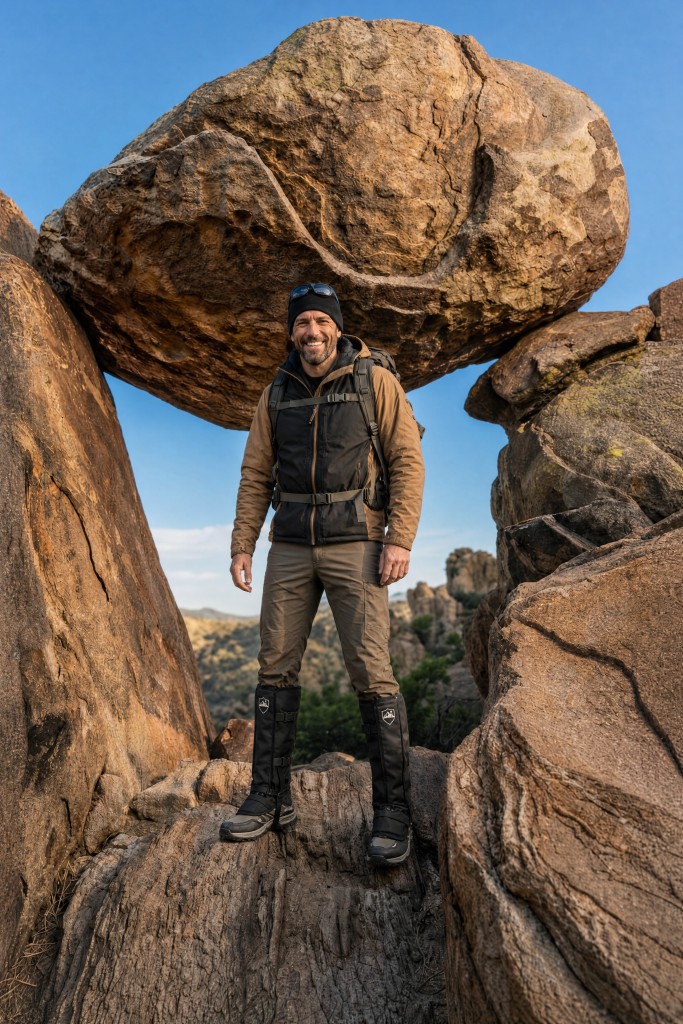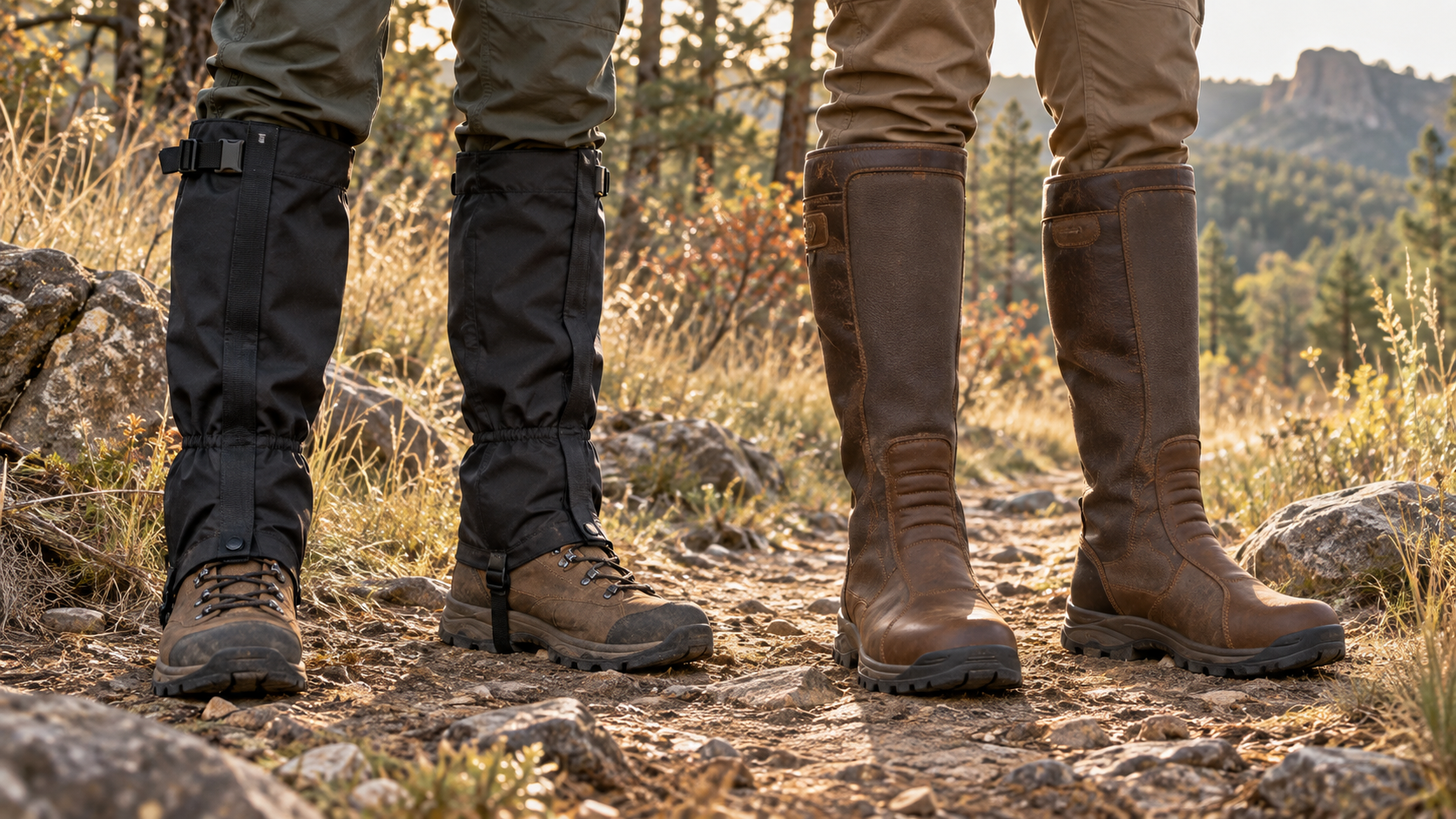
Comparing snake gaiters vs snake boots is not about finding one universal winner. Both are designed to add protection in snake country, but they differ in coverage, fit, convenience, footwear choice, and how they become part of your outdoor setup.
Snake gaiters are removable protective equipment worn over your pants and boots. Snake boots combine the footwear and protective shaft in one piece. Your best option depends on where you go, how often you need protection, which parts of the foot and lower leg you want covered, and whether you already own suitable outdoor boots.
This comparison explains the practical trade-offs without assuming that either design eliminates every risk.
Snake Gaiters vs Snake Boots at a Glance
| Consideration | Snake gaiters | Snake boots |
|---|---|---|
| Basic design | Removable protection worn over compatible pants and boots | Tall footwear with protection incorporated into the boot and shaft |
| Foot coverage | Usually depends on the separate boot underneath | May include the foot and lower leg within one protective product |
| Footwear choice | Allows you to keep using compatible hiking, hunting, or work boots | Requires you to use the integrated boot |
| Putting them on | Must be fitted and secured over clothing and footwear | Put on as a complete pair of boots |
| Removing protection | Can be removed while keeping your original boots on | Requires changing footwear |
| Packing | Can be carried separately and added when needed | Bulkier because the boot and protective shaft form one item |
| Fit considerations | Must fit the leg, clothing, and underlying boot | Must fit the foot, ankle, calf, and intended socks |
| Weather performance | Depends on both the gaiter and the boot underneath | Depends on the complete boot design and its stated specifications |
These are general differences, not guarantees. Individual products vary considerably, so always check the manufacturer’s coverage, test information, sizing, materials, and limitations.
What Are Snake Gaiters?
Snake gaiters are protective lower-leg coverings worn over pants and footwear. Most designs extend from the boot area to somewhere below the knee and use straps, buckles, hooks, or wraparound closures to remain in position.
Their main practical advantage is flexibility. You can continue using outdoor boots that already fit your feet and suit the terrain, then add or remove the gaiters according to the conditions.
This arrangement can be useful for hikers, hunters, anglers, property owners, and outdoor workers who move between maintained areas and brushy or overgrown ground during the same day.
The trade-off is that fit depends on multiple components. The gaiters must work with your calf size, pants, boot shape, lace arrangement, and walking movement. They also do not automatically protect every part of the foot covered only by the boot underneath.
What Are Snake Boots?
Snake boots are tall boots designed to combine footwear and lower-leg protection in one product. Depending on the model, the protective construction may extend through portions of the foot, ankle, and shaft.
The integrated design avoids the need to attach separate gaiters each time protection is required. It may appeal to people who regularly enter snake habitat and are comfortable dedicating a pair of boots to those conditions.
However, choosing snake boots means evaluating them as both protective equipment and footwear. The boots must fit your feet, heels, ankles, and calves while also providing suitable traction, support, flexibility, and weather performance for your activity.
A product described as a tall hunting or work boot should not automatically be treated as a snake-protection boot. Look for a clearly stated intended use and supporting information.
Which Option Provides More Coverage?
Coverage cannot be determined from product height alone.
Snake gaiters generally focus on the shin, calf, ankle area, and the transition to the boot. The foot itself normally depends on the footwear underneath. Some gaiters may leave areas around the heel, sides of the boot, or closure partially exposed.
Snake boots may incorporate protective construction through parts of the foot and lower leg, but the exact protected area varies by model. A tall shaft does not prove that every section uses the same materials or offers the same performance.
For either option, examine:
- The stated height and protected area.
- Front, side, and rear product views.
- Areas specifically excluded from protection.
- How seams, closures, and overlapping sections are constructed.
- Whether the test information applies to materials or the finished product.
Neither option normally protects the knee or upper leg unless the manufacturer explicitly states otherwise. People seeking higher coverage may also consider snake chaps, which should be evaluated separately.
Fit and Footwear Choice
Your relationship with your existing boots is one of the clearest differences between these products.
If you already own hiking, hunting, or work boots that fit well, offer suitable traction, and have been broken in comfortably, snake gaiters may allow you to keep using them. You still need to confirm that the gaiters are compatible with the boot shape and attachment points.
Snake boots replace that footwear. This can simplify the protective setup, but the complete boot must meet all your ordinary footwear requirements. Heel movement, toe space, arch support, traction, sock thickness, and calf fit all matter.
People searching for snake boots for men or snake boots for women should prioritize actual measurements and fit rather than relying only on gendered labels. Foot shape, calf circumference, intended socks, and activity are more useful selection criteria.
Movement, Weight, and Comfort
Comfort depends on the individual model and user, so it is not accurate to say that all gaiters are lighter or that all boots are more comfortable.
With gaiters, pay attention to stiffness around the ankle, pressure behind the knee, strap placement, and whether the product rotates as you walk. The combined weight of the gaiters and your chosen boots is what you will actually carry.
With snake boots, assess the complete boot. Tall shafts can affect ankle movement, heat, and the way you climb, crouch, or kneel. The benefit of an integrated design is limited if the footwear causes rubbing or does not suit the terrain.
Whichever option you choose, test the movements required by your activity before committing to a long outing:
- Walk at your normal pace.
- Step onto a low, stable surface.
- Climb and descend several safe steps.
- Carefully squat and bend your knees.
- Kneel if your activity requires it.
- Check for slipping, pinching, rubbing, or restricted circulation.
Convenience and Frequency of Use
Consider when and how often you expect to need snake protection.
Removable gaiters can be packed separately and added before entering tall grass, brush, rocky ground, or other areas with limited visibility. When the exposure changes, they can be removed while you continue wearing the same boots.
Snake boots may be more straightforward for someone who expects to wear protective footwear throughout the entire outing. There is no separate fitting step, although changing out of the protection means changing boots.
Neither approach is inherently more convenient for everyone. A person who encounters snake habitat occasionally may value removable equipment. Someone who works or hunts in those conditions routinely may prefer an integrated setup.
Mud, Rain, and Water
Do not assume that either snake gaiters or snake boots are waterproof simply because they are designed for outdoor use.
With gaiters, weather performance depends on the outer material, seams, closures, upper opening, and the separate boots underneath. Water-resistant fabric may help with splashes, damp vegetation, mud, or light rain without making the complete setup suitable for immersion.
Snake boots also vary. Some models may be marketed as waterproof, while others prioritize breathability, flexibility, or different forms of construction. Check the individual specifications rather than applying one expectation to the entire category.
Neither product should be treated as wading equipment or personal flotation equipment unless it was specifically designed and approved for that purpose.
Packing, Cleaning, and Inspection
Snake gaiters can usually be stored separately from your footwear. That makes it easier to keep muddy gaiters away from other equipment, but their straps, hooks, closures, seams, and protective sections require inspection.
Snake boots require the care expected for outdoor footwear as well as inspection of their protective shaft. Soles, uppers, seams, linings, and any damaged areas should be checked according to the manufacturer’s instructions.
For either product:
- Remove dirt and vegetation according to the care instructions.
- Allow the equipment to dry completely before enclosed storage.
- Look for cuts, punctures, worn seams, or damaged closures.
- Do not assume a cosmetic repair restores protective performance.
- Contact the manufacturer if damage affects a protective area.
How to Decide Between Snake Gaiters and Snake Boots
Snake gaiters may be the more practical option if:
- You want to continue using compatible boots you already trust.
- You only need additional lower-leg coverage during part of an outing.
- You want equipment that can be removed without changing footwear.
- You participate in several activities requiring different types of boots.
- You have confirmed that the gaiters fit your legs, clothing, and footwear.
Snake boots may be the more practical option if:
- You want the foot and lower-leg protection integrated into one product.
- You expect to wear the protective equipment for the entire outing.
- You are prepared to select new footwear for fit, traction, and support.
- The model’s weather performance suits your conditions.
- Its documented coverage and limitations match your intended use.
If neither list clearly describes your situation, start with terrain, expected exposure, and the area you want covered. Then compare individual products rather than relying only on category names.
Evaluate Protection Claims the Same Way
Whether you choose gaiters or boots, examine protection claims carefully. Terms such as “snake proof boots” or “snake proof gaiters” should not be treated as guarantees that every possible bite will be prevented.
Look for specific information about materials, construction, testing, fitting instructions, covered areas, and limitations. Ask whether testing applies to a material sample, a component, or the finished product.
AVENTURIX Snake Gaiters use a 1680D ballistic nylon outer shell with a PU coating and a protective inner layer. Product information states that the construction was tested by SGS using the ASTM F1342 puncture-resistance test method. Those details provide context, but they do not make any outdoor product risk-free.
For a more detailed selection process, read our guide to choosing snake gaiters.
Protective Equipment Does Not Replace Awareness
Boots or gaiters should support careful behavior, not encourage you to approach a snake or stop watching the ground.
The National Institute for Occupational Safety and Health guidance on venomous snakes advises outdoor workers to wear boots and long pants, avoid areas where snakes may be concealed when possible, and never touch or handle a snake.
Review official guidance for your destination, remain aware around rocks, logs, leaves, brush, and tall grass, and seek emergency medical attention promptly if a bite occurs.
Frequently Asked Questions
Do snake gaiters protect your feet?
Gaiters generally focus on the lower leg and ankle area. Protection for the foot usually depends on the boot underneath and the exact way the gaiter overlaps it. Check the product’s stated coverage rather than assuming the entire foot is protected.
Can snake gaiters be worn over any boots?
No universal compatibility should be assumed. Boot height, shape, lacing, sole design, and the gaiter’s attachments all affect fit. Test the complete combination before outdoor use.
Are all snake boots waterproof?
No. Weather protection varies by model. Review the manufacturer’s specifications for the complete boot and distinguish water resistance from waterproof construction.
Are snake gaiters better than snake boots?
Not in every situation. Gaiters offer removable coverage over compatible footwear, while snake boots integrate footwear and protection. The better choice depends on fit, terrain, coverage, frequency of use, and personal preference.
Choose the Option That Fits Your Routine
The most useful conclusion to a snake gaiters vs snake boots comparison is not that one category always wins. It is that each solves the footwear-and-coverage problem differently.
If you want removable lower-leg coverage that works with compatible boots you already own, you can explore AVENTURIX Snake Gaiters and follow the link to view current purchasing information on Amazon.